
The Floating Residence | Commentary | 2026
“Van life isn’t what it used to be.”
You hear it everywhere now — in the forums, in the comment sections, from the couple selling their Sprinter build after four years on the road. And broadly, it’s true. But the deterioration isn’t uniform, and the distinction matters more than the mood.
Van life as recreation is basically fine. Someone touring the national parks for three months, rotating campgrounds and BLM sites, faces more friction than in 2018 — more designated sites, more fee areas, more posted limits — but the trip still works. That version was always compliant with the 14-day logic of public land, because it never tried to outstay it.
Van life as a residential model is a different story. The “I sold my apartment, the van is my home” version — the one that drove the 2016–2022 boom — is in structural decline. Not a rough patch. Not a news cycle. Structural. And there are three reasons the trend has momentum rather than being a passing political mood.
1. The legal architecture is now self-propagating.
Since Grants Pass v. Johnson cleared the constitutional path in 2024, more than 350 cities and 14 states have adopted laws restricting public camping and sleeping. The newer statutes don’t just permit enforcement — they compel it. Florida, Georgia, and Oklahoma built private rights of action into their laws, meaning a single business owner can sue a city that fails to clear public sleeping. Enforcement no longer depends on political will. Meanwhile, model legislation from national think tanks means every state session can import the template cheaply.
That’s a ratchet, not a cycle. Cycles reverse. Ratchets don’t.
2. The tolerance that made it work was never a right — so there’s nothing to litigate back.
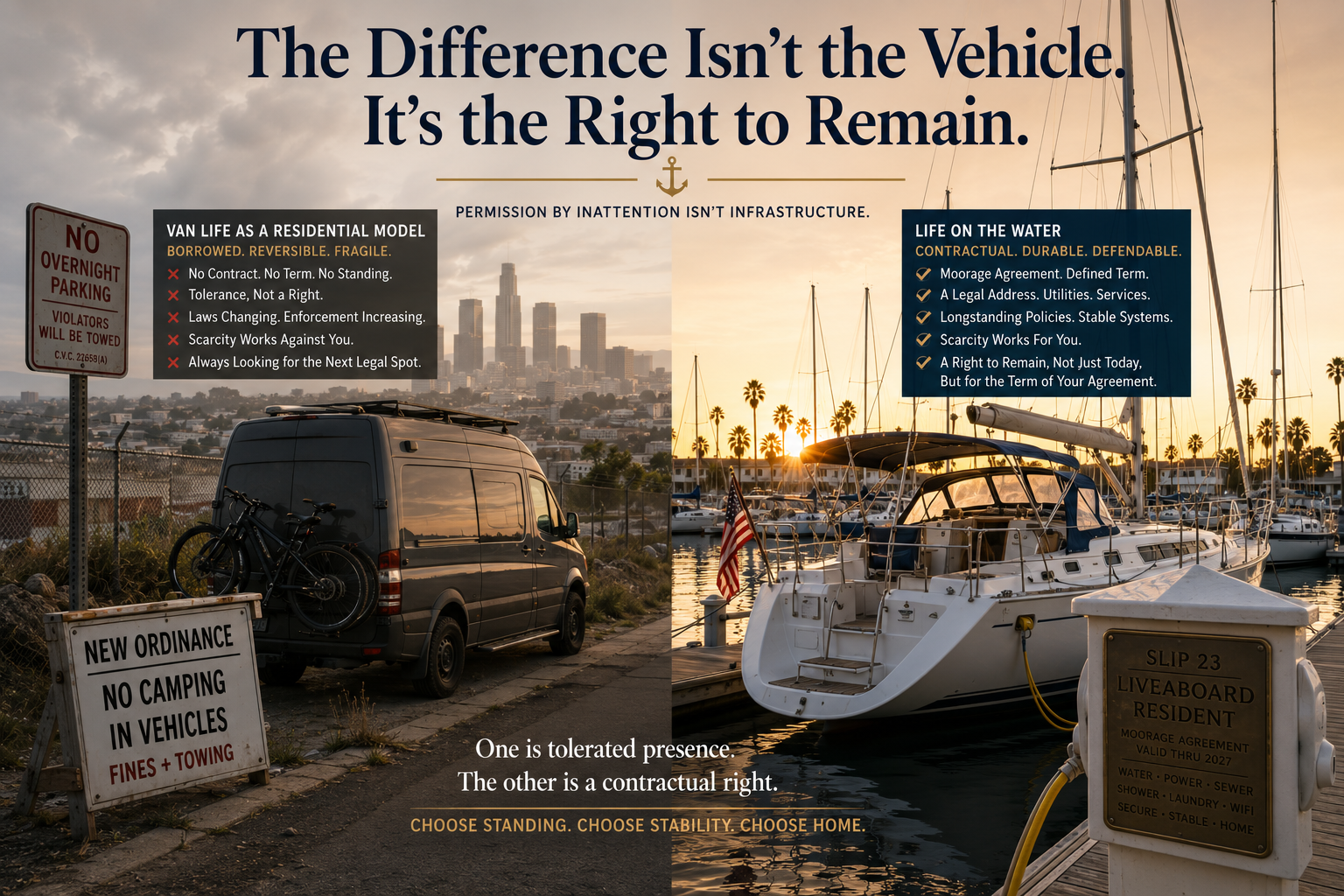
This is the piece most nomads underestimate. Van life’s legality was always permission by inattention: the unposted street, the tolerant parking lot, the under-patrolled corner of public land. Nobody granted it. It simply hadn’t been withdrawn yet.
When Los Angeles’s vehicle-dwelling ban was struck down in court, the city routed around the ruling within months — not by rewriting the ban, but by posting more than 1,300 oversized-vehicle parking zones, block by block. The lesson generalizes: when your legal position is “nobody has prohibited this yet,” you lose by default as prohibitions accumulate. There is no instrument to defend, no term to enforce, no standing to assert. You cannot litigate your way back into a right you never held.
3. The boom poisoned its own well.
Here’s the part that gets underdiscussed. The very surge that made van life a movement — the million-plus full-time vehicle dwellers, the crowded boondocking corridors, the visible overlap with vehicular homelessness in West Coast metros — is precisely what triggered the response. The ordinances, the conversion of open dispersed camping to designated sites around Moab and the Alabama Hills, the ranger patrols now checking rigs and tracking occupancy: all of it is demand exceeding the carrying capacity of inattention.
Van life didn’t get regulated because America turned against vans. It got regulated because it scaled.
The honest verdict
Put the three together and the nostalgia resolves into something sharper: van life as a residential model was never a durable system. It was an arbitrage on unenforced rules — and the arbitrage window is closing at legislative speed.
What happens next splits along lines of capital. The people who chose the lifestyle — who have income, savings, and options — will migrate: back to land, to hybrid arrangements, some to the water. The people who didn’t choose it get absorbed into the homelessness statistics, where vehicle dwellers are already the fastest-growing and least-counted population. That grimmer half of the story deserves to stay visible. A residential category is collapsing, and not everyone in it has an exit.
So how does life on the water compare?
Carefully — because the lazy answer is wrong, and the real answer is more interesting.
The lazy answer is that the ocean is the loophole the road used to be: boundless water, no parking signs, anchor anywhere. Anyone who trades a van for a boat on that theory is simply re-running the van life experiment with worse maintenance costs. Anchorages are regulated. Florida — the same state that produced HB 1365 — has spent a decade tightening anchoring limits and derelict-vessel enforcement. Liveaboard-friendly marinas are scarce, frequently waitlisted, and governed by policies that vary harbor to harbor. The nomadic fringe of floating living faces the same enforcement gravity as the nomadic fringe of vehicle living, for the same reason: tolerated presence is tolerated presence, whether it floats.
But run the comparison on the variable that actually broke van life — the durability of your right to remain — and the two models diverge categorically.
A liveaboard slip is a contractual right to remain. A parking spot is the temporary absence of a prohibition. The marina liveaboard holds a moorage agreement: a defined space, a defined term, defined fees, utilities, a legal address, and standing that resembles tenancy. The van dweller in full legal compliance holds nothing — no instrument, no term, nothing to enforce — only a position any city council can extinguish with a sign. One legality is possessed. The other is borrowed.
The regulatory trajectories point in opposite directions. Land-side rules on vehicle dwelling are deteriorating at legislative speed — 350-plus cities in two years, with model bills accelerating the spread. Residential marina policy isn’t liberalizing, but it isn’t collapsing either: liveaboard programs are long-standing, quota-managed, and administratively stable precisely because they’re contractual and revenue-generating. A marina has no incentive to legislate away its own paying residents. A city has every incentive — and in Florida, a legal obligation — to legislate away van dwellers who pay it nothing.
Scarcity works for one and against the other. For the van dweller, scarcity is adversarial: every new ordinance shrinks the free map, and holding position confers no rights. For the liveaboard, scarcity is proprietary: capped liveaboard quotas, finite waterfront, and multi-year waitlists are exactly what make secured access durable — and arguably appreciating. One population is being displaced by scarcity. The other is protected by it.
The infrastructure is real rather than improvised. Shore power, water, pump-out, showers, laundry, an address the DMV accepts — the marina supplies as ordinary infrastructure what the van dweller assembles daily from gym memberships, apps, and luck. The invisible tax of van life is finding tonight’s legality, every night. The liveaboard paid that tax once, at the waitlist.
To be clear about scale: floating living cannot absorb the van life exodus. Residential marina capacity in the United States is measured in thousands of slips, not hundreds of thousands of nomads — and for the demographic core of vehicular homelessness, the answer is housing policy, not vessel acquisition. The comparison isn’t a pitch to a crowd. It’s a lens for the individual decision.
For those who do have an exit, the takeaway isn’t “buy a different vehicle” — or even “buy a boat.” It’s that the vehicle was never the constraint. What failed wasn’t the van; it was the assumption that tolerated presence could substitute for a durable, contractual right to remain somewhere. The next residential decision, on land or water, should be shopped on that variable first: not the asset, but the standing. On the water, that instrument exists, it has a name, and its scarcity is the argument for securing it early rather than the argument against it.
The road didn’t close because America hates vans.
It closed because permission-by-inattention isn’t infrastructure.
The Floating Residence researches floating living as a residential system — through geography, marina infrastructure, vessel suitability, financial structure, and lifestyle compatibility. This commentary is for informational purposes only and does not constitute legal, financial, or real estate advice.