
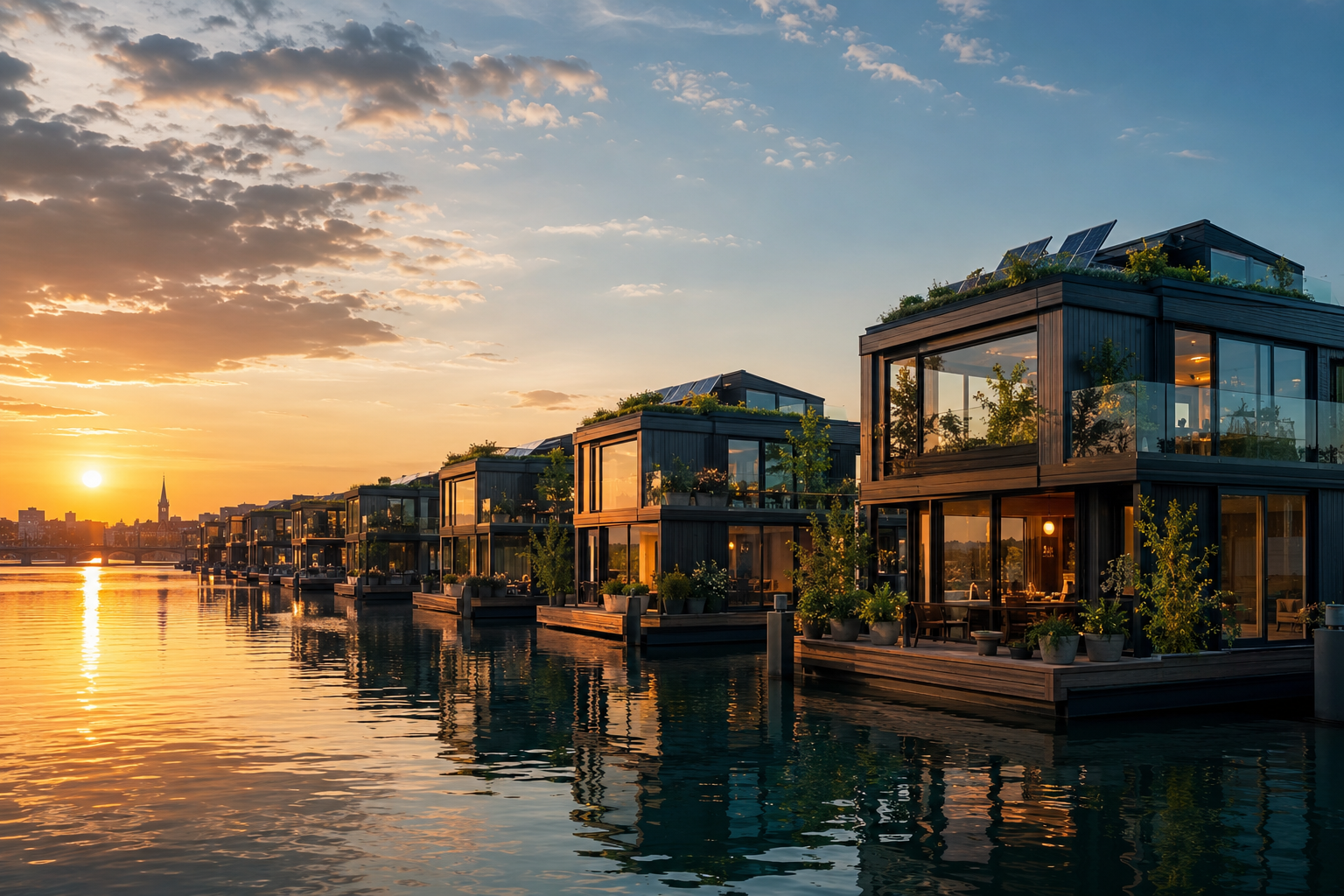
What the Dutch Are Teaching the World About the Future of Living
Executive Perspective
For centuries, cities have expanded outward across available land. Today, that assumption is increasingly under pressure.
Rising housing costs, land constraints, climate-related flooding, and population growth are forcing governments, developers, and residents to reconsider a fundamental question: what happens when conventional land-based expansion becomes more difficult, expensive, or environmentally challenging?
The Netherlands may offer one of the most compelling answers.
Long recognized for its sophisticated relationship with water, the country has become a global leader in floating residential development. What began as a practical response to flood risk and limited land availability has evolved into a broader model for urban resilience—one that is now influencing projects from Scandinavia to the Maldives.
Rather than treating water solely as a threat to be controlled, Dutch planners increasingly view it as a resource to be utilized.
That shift in thinking may prove to be one of the most important urban planning developments of the 21st century.
A Different Relationship With Water
The Dutch approach differs fundamentally from traditional flood-defense strategies.
Historically, cities have attempted to resist water through seawalls, levees, drainage systems, and land reclamation. The Netherlands pioneered many of these techniques. Yet in recent decades, Dutch planners have increasingly adopted a complementary philosophy: adapt to water rather than simply fight against it.
Floating homes embody this concept.
Unlike traditional houseboats, modern floating residences are permanently connected to utilities and infrastructure while remaining capable of rising and falling with changing water levels. Built upon engineered concrete foundations and secured by guide piles, these homes are designed to accommodate flooding rather than suffer from it.
The result is a housing model that remains functional even as water levels fluctuate.
For communities facing increasing flood exposure, this represents a notable departure from conventional residential development.
Solving Two Challenges Simultaneously
The appeal of floating housing extends beyond climate adaptation.
Many developed nations face a dual challenge:
- A shortage of buildable land.
- A shortage of affordable housing.
In the Netherlands, where significant portions of the country lie below sea level, these realities are particularly acute.
Floating developments create an opportunity to expand housing capacity without consuming additional land resources. Areas previously viewed as unusable can become residential districts, commercial zones, educational facilities, and community spaces.
Amsterdam’s Schoonschip neighborhood has become one of the most visible examples of this concept in practice. Residents share renewable energy resources, utilize heat pumps, generate solar power, and operate within a highly collaborative community framework.
The neighborhood demonstrates that floating living is not merely a technical solution—it can also support new approaches to sustainability and resource efficiency.
From Floating Homes to Floating Cities
What began as small-scale experimentation is rapidly evolving.
Dutch engineering firms are now contributing to significantly larger developments around the world.
Perhaps the most ambitious example is the Maldives Floating City project, designed to provide housing for approximately 20,000 residents in one of the world’s most climate-vulnerable nations.
The Maldives faces a unique challenge: roughly 80% of the country sits less than one meter above sea level. Traditional land expansion offers limited long-term certainty.
Floating infrastructure offers an alternative path.
Other concepts under consideration include floating districts in Scandinavia, mixed-use floating communities in French Polynesia, and large-scale floating island developments in the Baltic Sea.
While many of these projects remain in development stages, the trend is unmistakable: water is increasingly being viewed as developable space.
Challenges Remain
Floating communities are not without obstacles.
Infrastructure costs can be significant. Utility connections require specialized engineering. Building codes and zoning regulations often lag behind technological capabilities. Residents must also adapt to subtle movement caused by weather and wave activity.
Scaling floating developments from dozens of homes to thousands of residents presents additional complexity.
Yet these challenges increasingly resemble the early hurdles faced by other transformative forms of urban development.
Few people questioned the practicality of skyscrapers once elevators became reliable. Similarly, floating infrastructure may eventually transition from novelty to accepted urban planning tool.
The critical question is no longer whether floating communities are possible.
It is whether societies are prepared to integrate them at meaningful scale.
What This Means for The Floating Residence
The Floating Residence exists at the intersection of several powerful long-term trends.
Too often, discussions surrounding boat living or floating lifestyles focus narrowly on recreation, retirement, or alternative housing. While those elements remain important, they overlook a broader reality.
Floating living represents participation in an emerging category of residential adaptation.
The Dutch experience demonstrates that floating environments offer advantages that extend beyond housing costs:
Efficient Use of Limited Resources
As developable land becomes increasingly constrained in desirable regions, water provides an underutilized frontier for residential expansion. Floating communities allow cities to grow without consuming additional terrestrial space.
Climate Resilience
Unlike conventional structures that must resist rising water, floating residences can adapt alongside changing conditions. While not a universal solution, they represent a meaningful resilience strategy in specific geographic environments.
Sustainable Living Potential
Many floating communities naturally encourage localized energy production, shared infrastructure, reduced land disturbance, and closer integration with renewable technologies.
Lifestyle and Mobility
Floating living introduces a dimension often absent from traditional housing: optionality.
Whether through liveaboard vessels, floating homes, marina communities, or hybrid residential arrangements, residents gain access to experiences and locations that conventional housing rarely provides.
A Shift in How We Define Real Estate
Perhaps most importantly, floating living challenges traditional assumptions about what constitutes residential value.
For decades, residential wealth creation has been tied almost exclusively to land ownership.
The Dutch model suggests another possibility: that access, adaptability, resilience, and efficient use of scarce resources may become increasingly valuable forms of residential capital in their own right.
Final Thought
The Netherlands is not building floating communities because they are novel.
It is building them because water, climate, housing demand, and land scarcity are forcing new solutions.
The broader lesson extends well beyond Europe.
As coastal populations continue to grow and climate pressures intensify, the question may no longer be whether humanity builds on water.
The question may be how intelligently we choose to do so.
For those exploring floating lifestyles today, they may be witnessing not merely an alternative way of living—but an early glimpse of a larger residential evolution.
Leave a Reply