
What Superyacht Liveaboards and Marina Liveaboards Are Actually Buying
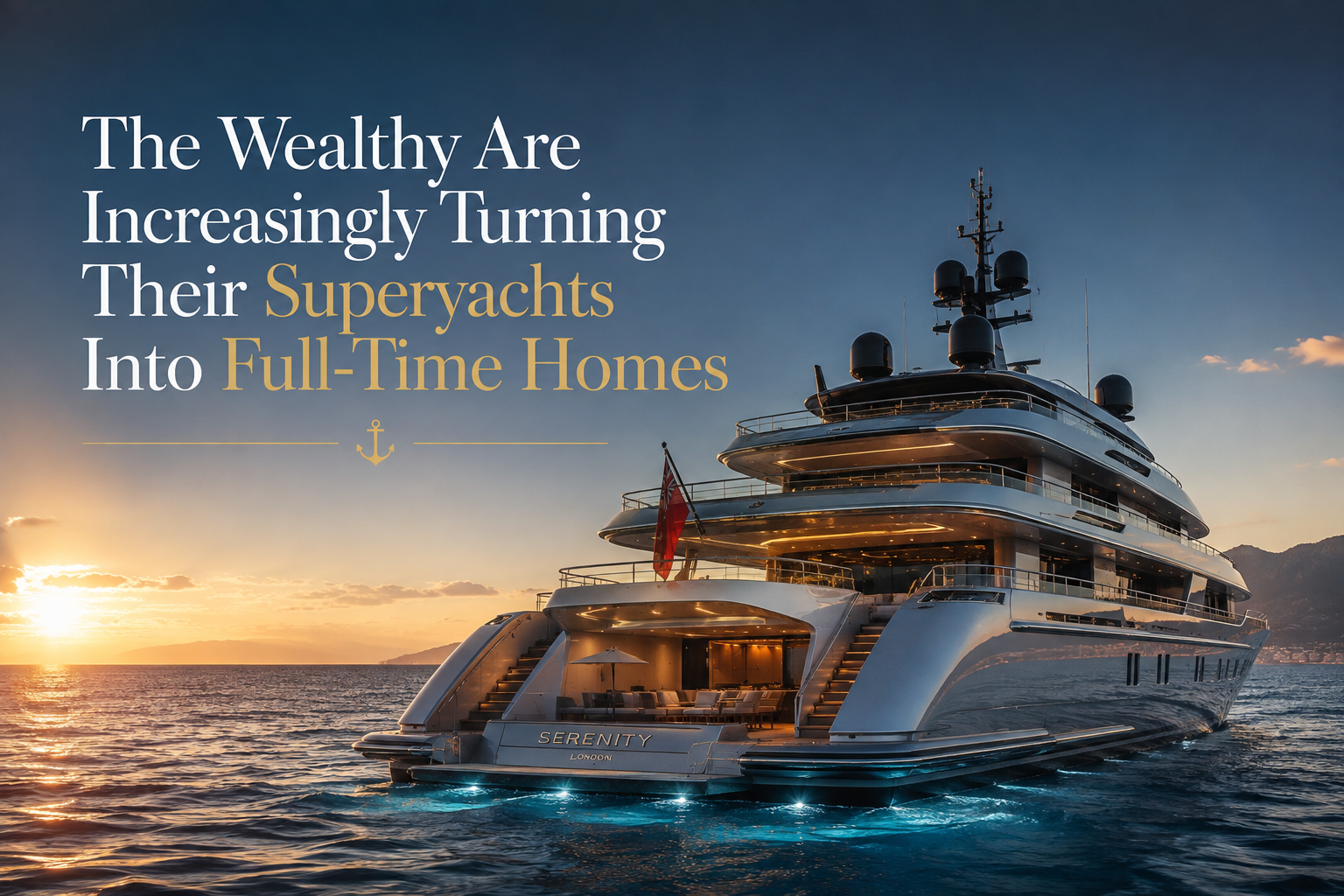
A recent Robb Report feature carried a headline that will read, to most people, as a curiosity about the ultra-wealthy: owners are turning their superyachts into full-time homes. Gabe Newell has been living aboard the 364-foot Leviathan since 2021. A Majesty 112 owner runs a business from marina to marina with no fixed address. An Oyster 595 owner is circumnavigating with his family as part of the Oyster World Rally, treating the boat not as a vacation asset but as the only residence he currently has. Many owners are turning yachts into their primary residences to lead a lifestyle centered on freedom and mobility.
None of this should be filed under lifestyle journalism and forgotten. Read correctly, it is a natural experiment running at the opposite end of the capital spectrum from where most floating residence discussions occur — and it arrives at the same conclusion.
The vessel was never the constraint. It never is.
The Symmetry Nobody Names
Strip away the zeros and the two stories look identical. A resident acquires a vessel. The vessel alone does not make the arrangement work. What makes it work — what determines whether the person is actually living somewhere, rather than owning a very expensive object that happens to float — is a second, less visible layer: the system of infrastructure, access, and standing permission that lets the vessel function as a residence rather than a recreational asset in storage.
At the marina liveaboard level, that system is a slip agreement and a liveaboard permit, and the binding constraint is scarcity — there are more prospective residents than there are residentially zoned slips in most desirable harbors. At the superyacht level, the Robb Report piece makes clear the constraint has simply changed shape. Erwin Bamps, CEO of Gulf Craft, describes clients who “don’t want to buy a boat; they want to buy real estate on the water” — and then spends the rest of the interview describing engineering problems: wardrobe capacity for people who no longer have a closet on land, waste management for a family accumulating a month of trash at sea, power demand from appliances the boat’s electrical system wasn’t built to support, ovens recalibrated because a client’s cakes weren’t turning out right three thousand miles from her usual kitchen.
These are not boat problems. They are residence problems that happen to be occurring on a boat. The infrastructure bottleneck did not disappear because the client can afford a $50 million vessel. It moved — from marina slip availability to onboard systems capacity, from a liveaboard permit issued by a harbor district to a hybrid propulsion system quiet enough to sleep through, from municipal regulation to flag-state and provisioning logistics. But it is recognizably the same category of problem, and it is doing the same thing in both cases: determining whether the vessel can actually function as a home, independent of whether the vessel itself is desirable.
A Majesty 112 is not, in any engineering sense, less capable of crossing an ocean than it was five years ago. What changed is the infrastructure wrapped around it — Starlink for continuous connectivity, extended range on less fuel, stabilization systems built for comfort rather than performance. The vessel became residential when the system around it did, not before.
What the Superyacht Buyer Is Actually Purchasing
Bamps’s phrase — “real estate on the water,” not “a boat” — is worth sitting with, because it is a layperson’s attempt to name something that has a more precise description.
Real estate, as a category, is valuable primarily because of what it confers: a legally durable right to occupy a specific place, recognized and enforced by a surrounding system of title, zoning, and law. When Bamps’s clients say they want “real estate on the water,” they are not describing the hull. They are describing a desire for that same durable, structural relationship to a place — just delivered through a vessel instead of a deed.
But a superyacht does not actually confer that. What it confers is the option of that relationship, contingent on a much longer chain of access: available berths in the harbors the owner wants to use, flag-state compliance, crew, provisioning networks, fuel range, and — increasingly, per Bamps — the willingness of shipyards to engineer for full-time residential load rather than for a six-week charter season. The yacht is closer to owning a extremely well-appointed RV with no fixed campsite than it is to owning real estate. It is possessed — fully owned, no permission required to exist — but the right to remain anywhere specific is borrowed, negotiated berth by berth, jurisdiction by jurisdiction, season by season.
This is the same possessed/borrowed distinction that governs a liveaboard permit at a municipal marina, just inverted. The Santa Barbara liveaboard resident owns a comparatively modest vessel outright but holds a contractual, permitted right to remain at a specific slip — a right that is scarce, administratively granted, and revocable, but which is, while it holds, more durable and more specific than anything the superyacht owner has. The superyacht owner owns a vastly more capable and expensive vessel outright, but has no equivalent standing claim to any particular piece of water. He has global mobility and no fixed right to remain; the marina liveaboard has a fixed right to remain and comparatively little mobility. Each is trading one form of security for the other.
Neither is a housing solution in the conventional sense. Both are residential systems built around a vessel, and in both cases, the vessel is the less interesting variable.
Why the Vessel Keeps Getting the Credit It Doesn’t Deserve
The recurring error in how floating living gets covered — at any price point — is treating the vessel as the unit of analysis. It is understandable: the vessel is visible, photographable, and priced. The system around it is not.
Robb Report’s own reporting undercuts this framing without appearing to notice it does so. The most consequential sentence in the piece is not about a boat at all — it’s Bamps’s observation that shipyards are now hiring former real estate agents to sell yachts, because the sales conversation has shifted from performance specifications to something closer to a residential listing. That is an infrastructure story wearing a design story’s clothes. It signals that the entire category — from a modest marina liveaboard to a 364-foot megayacht — is being re-priced and re-marketed around the same underlying asset: durable access to a place to live, not the vessel that provides it.
The three owners interviewed all describe the same tradeoff structure, whether or not they’d use this language. Mobility in exchange for administrative complexity. Independence from land-based housing markets in exchange for dependency on marine systems, weather, and — even at the top of the market — the availability of a berth. The Oyster 595 owner, circumnavigating with his family, notes almost in passing that anchoring means staying alert to nearby boats, swing room, and shifting weather — the ordinary vigilance of not having fixed ground underneath him. That is an infrastructure and access constraint, not a lifestyle preference. It is the superyacht-scale version of a liveaboard resident checking a harbor district’s slip waitlist.
The Takeaway
Robb Report frames this trend as a story about changing values — remote work, post-pandemic reassessment, a generational shift toward experience over accumulation. All of that is almost certainly true and almost entirely beside the point. The more durable finding, buried inside the anecdotes and unremarked upon by anyone quoted, is that floating living does not stop being a housing systems decision once the vessel gets larger. It simply relocates the constraint.
At every scale, the sequence is the same: objectives, then access, then vessel — not the reverse. The wealthiest buyers in this market are re-learning, one wardrobe redesign and one waste-management system at a time, what marina liveaboards already know by necessity. The boat was never the hard part.
Leave a Reply