
What 384 Feet of Yacht in Venice Reveals About Living on the Water
The Floating Residence | Editorial Analysis | July 2026
On July 17, roughly three hundred Venetians marched toward Riva dei Sette Martiri to protest a boat. Not boats generally — one boat. The Boardwalk, a 384-foot Lürssen delivered in May to Tilman Fertitta, the billionaire U.S. ambassador to Italy, had anchored off the historic center as part of a two-month “Coastal Diplomacy 250” tour of thirteen Italian coastal regions. Police cordons kept the marchers away from the water. Earlier this month, organizers had unfurled a banner reading “Venezia non si USA” — Venice is not to be used — cut deliberately to the same length as the yacht itself.
The protest was, on its surface, about American politics, mass tourism, and the use of a fragile city as a backdrop. But embedded in the organizers’ statements was a housing grievance: the difficulty of making ends meet and finding a home in Venice while a vessel reportedly costing $450 million idles offshore with two helipads, a cinema, a putting green, and eleven staterooms.
That grievance deserves to be taken seriously — and taken apart carefully. Because the object of the protest and the subject of this publication share exactly one thing: a hull. Everything else about them belongs to different economic universes. Understanding why matters for anyone who lives on the water, regulates it, insures it, or is considering it as a residential pathway.
The most visible boat in the world
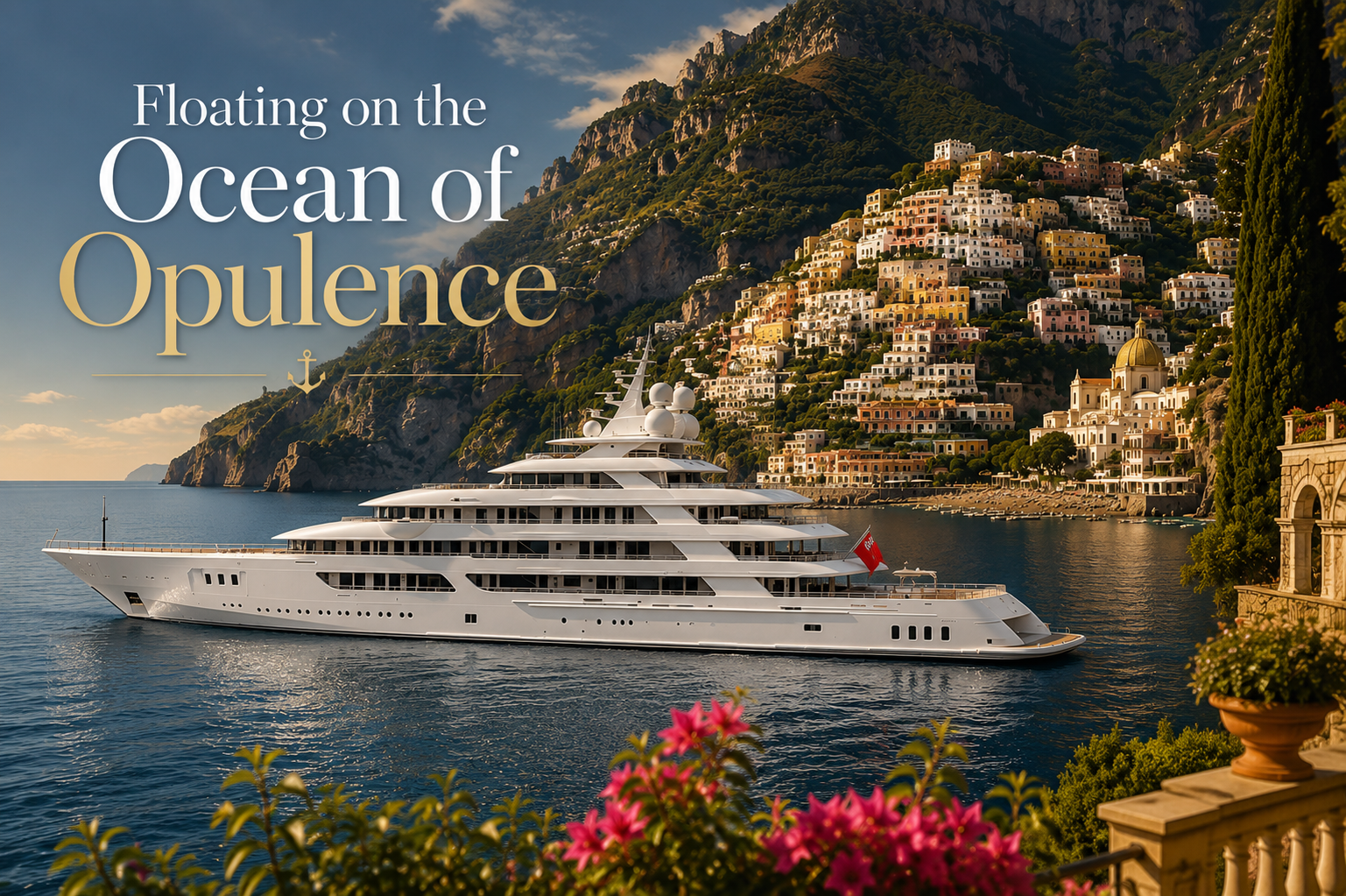
The Boardwalk is a remarkable machine, and there is no analytical value in pretending otherwise. At 5,602 gross tons, it is the largest of at least six vessels Fertitta has owned under the same name. Lürssen, the German builder with the deepest experience in vessels over 100 meters, engineered a retractable structural deck plate — a first for the yard — along with roughly 3,000 exterior lighting points and a glass-walled engine room catwalk. The tender garage holds three custom 40-foot boats, an amphibious craft, and a fleet of land vehicles. Lürssen describes it as a true ship wearing the guise of a yacht.
It is also, in the framework this publication uses, not a residence. It is a consumption platform — arguably the most sophisticated one afloat. The distinction is not a moral judgment. It is a structural one, and it shows up in three places: the capital, the crew, and the contract.
The capital: depreciation at scale
Start with what happened to the previous Boardwalk. Fertitta took delivery of a 250-foot Feadship in 2021. By late 2025 it was on the market — listed initially around $192 million, with reporting this spring placing the asking price near $174.5 million. Whatever the eventual sale price, the trajectory is the familiar one: a vessel is a depreciating asset, and the curve does not flatten because the owner is a billionaire. It simply operates with more zeros.
This is the same principle we have documented at the opposite end of the market, where a used 35-foot motor yacht purchased for the price of a car depreciates predictably while the thing that appreciates — or at least holds scarcity value — is the slip: the contractual right to occupy residentially viable marina infrastructure. In California, the liveaboard permit and the slip permit are separate instruments, and the slip is the load-bearing one. The vessel is the wasting component of the system. The infrastructure access is the durable component.
The superyacht economy has no durable component. It is all vessel. There is no slip permit for a 117-meter hull because almost no marina on earth is built to receive one as a residence. Which brings us to the second distinction.
The crew: a hotel, not a home
The prior Boardwalk carried 14 guests and 22 crew. The new one is larger. A vessel that requires more staff than it can sleep guests is not housing under any definition a housing analyst would recognize. It is a hospitality operation — which is fitting, since Fertitta built his fortune in hospitality, and the interiors of his previous yacht were reportedly modeled on his Houston hotel.
A liveaboard vessel inverts every one of those ratios. One or two residents. Zero crew. The occupant is simultaneously the owner, the maintenance department, the utilities manager, and the person who wakes up when a dock line groans at 3 a.m. The marine maintenance burden is real and lumpy — a haul-out does not care about your monthly budget — and it lands on the resident, not on 22 uniformed professionals. This is precisely why we treat lifestyle compatibility and maintenance capacity as core feasibility variables rather than footnotes. Floating residence living is not yachting with less money. It is a different activity that happens to share a medium.
The contract: possessed legality versus borrowed legality
The third distinction is the one Venice made visible, and it is the most important.
To hold his position off Riva dei Sette Martiri during one of the city’s most significant festivals, Fertitta required the cooperation of Italian authorities and the deployment of police — enough of them that a national opposition party accused the government of diverting hundreds of officers from public safety duties. His presence on that water was negotiated, contested, and defended by force of state. The moment the political weather changes, the anchorage goes with it. Three hundred protesters and a banner nearly made it go this week.
That is borrowed legality — the same category of tenure we have analyzed in the context of anchor-outs in Richardson Bay and vehicle dwellers after Grants Pass. The occupant’s right to remain exists at someone else’s discretion and can be withdrawn without breach of any agreement, because there is no agreement.
A marina liveaboard with a slip permit and a liveaboard permit holds the opposite: possessed legality. A contractual right to remain, renewed on defined terms, enforceable in the ordinary way contracts are enforceable. It is unglamorous. It fits in a file folder. And it is the single thing the most expensive private vessel in Italian waters did not have this week. The irony is worth stating plainly: a $450 million yacht anchored off Venice enjoys weaker residential tenure than a $30,000 trawler with a signed slip agreement in a municipal harbor. Money bought the hull. It could not buy the contract, because in Venice — as in most of the world’s desirable waterfronts — that contract does not exist to be bought.
Why the conflation is costly
Here is where the Venice protest stops being a story about one ambassador and becomes a structural problem for an entire residential category.
When the public — and, more consequentially, when harbor commissions, city councils, insurers, and lenders — hear “living on a boat,” the image that loads is the most visible boat available. This week, that image is 384 feet long, carries a putting green, and required a police cordon. The tens of thousands of Americans who live aboard modest vessels in marina slips, paying moorage that functions as their housing cost, are invisible in that frame. They absorb the reputational spillover of a spectacle they have nothing to do with.
The protest signs read “no space for billionaires.” Fair enough as politics. But the policy instruments that get written in the wake of such sentiment — anchoring restrictions, vessel-size ordinances, tightened residential moorage rules — rarely distinguish between the gigayacht and the liveaboard. Blunt instruments fall hardest on the smallest hulls. We have seen this pattern before: enforcement regimes designed with one image in mind, applied to a population that looks nothing like it.
The floating residence sector’s exposure here is not that superyachts exist. It is that no institution currently maintains the data, the definitions, or the frameworks to make the distinction legible to regulators. A category that cannot describe itself gets described by its loudest example.
The honest contrast
So: a boat can be survival, and a boat can be opulence. But that framing, while emotionally true, is analytically incomplete. The sharper version is this.
One vessel is a system — geography, infrastructure, contract, capital structure, and daily life, aligned into functioning housing at a fraction of the cost of the waterfront real estate beside it. The other vessel is an object — extraordinary, engineered to the edge of what a shipyard can do, and structurally incapable of being housing no matter how many staterooms it carries, because it has no infrastructure to belong to, no contract to stand on, and a cost basis that only depreciation can resolve.
Venice protested the object. The system was never in the harbor. It rarely is, in the public imagination — and that gap in understanding, more than any banner, is what this publication exists to close.
Disclosure: The author has lived aboard a 35-foot motor yacht at Santa Barbara Harbor since 2018 and holds slip and liveaboard permits there. The Floating Residence maintains a disclosed-interest policy for all content referencing that harbor.
Sources: Reuters and NBC News reporting on the July 17, 2026 Venice protests; Forbes (Katia Damborsky, May 14, 2026) on the delivery of the Lürssen Boardwalk; contemporaneous reporting on the listing of the prior Feadship Boardwalk.