
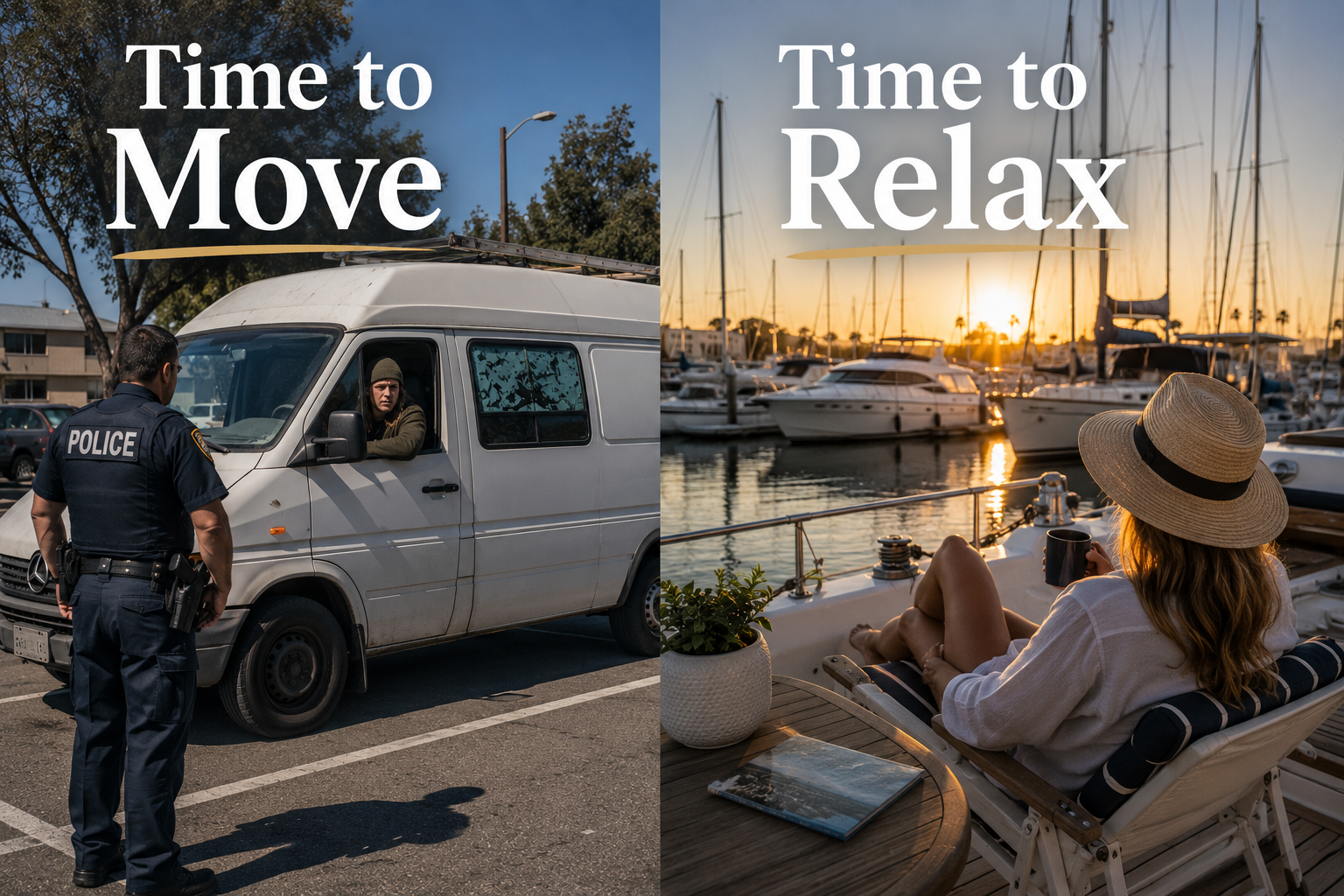
A Van Lifer Buys Lunch, Parks Legally, and Gets Nineteen Minutes. What Happens Next Explains the Whole Crisis.
The Floating Residence | Commentary | 2026
The video is nineteen minutes long, and the food is still hot at the end of it.
A working van lifer in St. Petersburg, Florida — employed, housed in her vehicle by the math of the local rental market, four years into the lifestyle — pulls into a Wawa. She buys lunch at 12:12, receipt time-stamped. She sits in her driver’s seat, windows up, eating and taking a phone call. Within twenty minutes, a security guard is at her window telling her she needs to leave the property.
The exchange that follows deserves close reading, because it is the entire van life crisis compressed into a parking lot.
Asked what rule she’s broken, the guard offers a phrase that belongs in the historical record of this era: “prolonged sitting.” Asked what the allotted time actually is, he explains that he and a manager “decided on maybe fifteen minutes” — and then, mid-conversation, revises his own number downward, suggesting five minutes would be more appropriate: enough to get in, pick a direction, and go. Law enforcement is summoned over a woman eating food she bought at the establishment whose parking lot she’s sitting in.
The coda is the part that matters most. She calls the store’s actual manager afterward. He’s never heard of the incident. There is no fifteen-minute policy. There is no five-minute policy. People eat in their cars there all the time, he tells her; it never should have happened.
Sit with that. The rule did not exist. The enforcement happened anyway.
The rule was never the point
Our recent analysis of the post-Grants Pass legal wave — 350-plus cities, fourteen states, Florida’s HB 1365 with its private-enforcement architecture — described van life’s foundation as permission by inattention: a legality made of nobody-has-prohibited-this-yet. The St. Petersburg video demonstrates the corollary, and it’s worse than the statutes suggest.
Where you hold no standing, you don’t even need a rule to be removed. You need only a person with discretion and a hunch about your category. The guard didn’t cite an ordinance; he improvised one, negotiated it downward in real time, and escalated to police when it was questioned — against someone who was, by the property’s own management, entirely within her rights. Other people were eating in their cars in that lot. They weren’t approached. She was driving a large van.
This is the enforcement layer beneath the legal layer. Statutes like HB 1365 formally exempt the legally parked, registered, insured vehicle — we’ve written about that carve-out and its trap door. But the video shows what the carve-out is worth at street level: the van dweller’s presence is interrogated presence, everywhere, at any hour. She makes this point herself, and it’s analytically sharp: the majority of the harassment she’s experienced has come not at night, not while sleeping, but in daylight — public parks, grocery runs, a gas station lunch. The overnight rules were never the real perimeter. The category was.
Her math is correct — that’s the trap
It would be easy to wave this away with “then stop doing van life,” and her video pre-empts the comment with better economics than her critics bring. Rent in her area would consume so much of the household’s income that one medical or vehicle emergency puts them back in the van anyway — minus their savings. Campgrounds, the other stock answer, now price at rent-equivalent levels once you add power and water. Move somewhere cheaper? Wages are relative to local cost of living; the arbitrage rarely survives the job change.
She’s not describing a lifestyle preference. She’s describing a working household using a vehicle as a savings mechanism because the local housing market broke the conventional path — and being treated, in her words, as someone the city simply doesn’t want to exist. Employed. Above assistance thresholds. Below the mortgage market. There is a name for the thing she’s missing, and it isn’t a better van.
The variable she’s naming without naming it
Near the end, she lands on a line worth engraving: van life looks like freedom, but freedom doesn’t work without public space — places to rest, park, exist.
Close — but the diagnosis can be pushed one turn further. The problem isn’t that public space is disappearing, though it is. The problem is that her entire residential model runs on space governed by someone else’s discretion: the city’s, the corporation’s, the land manager’s, and ultimately one security guard’s mood at lunchtime. Freedom built on discretionary space isn’t freedom. It’s a lease with ten million landlords, any one of whom can knock on the window.
What she needs — what every working vehicle dweller in that video’s comment section needs — is the thing the guard couldn’t have challenged: standing. A space where her presence requires no justification because it’s hers by instrument, not by tolerance.
Two miles from that parking lot, the water
Here is the detail that makes this particular video almost allegorical: it was filmed in St. Petersburg — a peninsula city, ringed by water, home to one of the larger municipal marina systems on the Gulf Coast. The confrontation over nineteen minutes of parking happened within a short drive of hundreds of boat slips.
We won’t romanticize the comparison, because the honest version is stronger than the romantic one. A liveaboard slip is not an easy answer: liveaboard-permitted slips are scarce, waitlisted, and quota-capped; a habitable boat costs real money; Florida has spent a decade tightening anchoring rules against exactly the drift-and-hope version of water living that would tempt a refugee from van life. The slip right and the right to live aboard are separate instruments, and anyone who acquires the first assuming the second repeats the van life mistake on water.
But observe what the liveaboard holding both instruments possesses that no van dweller in America does. A moorage agreement — defined space, defined term, defined fee, utilities, a legal address. When she eats lunch in her cockpit, no one approaches, because there is no discretion to exercise: her presence is the contract performing as written. Her counterparty is not ten million property managers; it’s one harbor office that cashes her check. Our own published case study documents the ledger in one of America’s most expensive coastal cities: $579.05 a month to the municipality, water included, for the right to be somewhere on the water — no improvised time limits, no revised allotments, no one deciding in real time how many minutes of existence are appropriate.
The difference between her position and that one isn’t the vehicle. A van and a boat are both depreciating boxes someone lives in. The difference is that one box sits in space held by permission, and the other sits in space held by agreement. “Prolonged sitting” is only an offense in the first kind.
The takeaway
The woman in the video says she may quit van life — not from burnout, but because the country is making her category of existence unlivable. She’s reading the trend correctly. Our advice to anyone standing where she stands is not “buy a boat.” It’s narrower and more transferable: whatever you do next, stop shopping for spaces that tolerate you and start shopping for the instrument that makes tolerance irrelevant. On land that instrument is a lease or a deed, priced at the crisis that put her in the van. On the water, it exists at a different price point — scarce, imperfect, waitlisted, and worth understanding before the waitlists say otherwise.
Nineteen minutes. The food was still hot. That’s how long permission lasts now.
Standing doesn’t expire at minute fifteen.
The Floating Residence researches floating living as a residential system — through geography, marina infrastructure, vessel suitability, financial structure, and lifestyle compatibility. This commentary is for informational purposes only and does not constitute legal, financial, or real estate advice.