
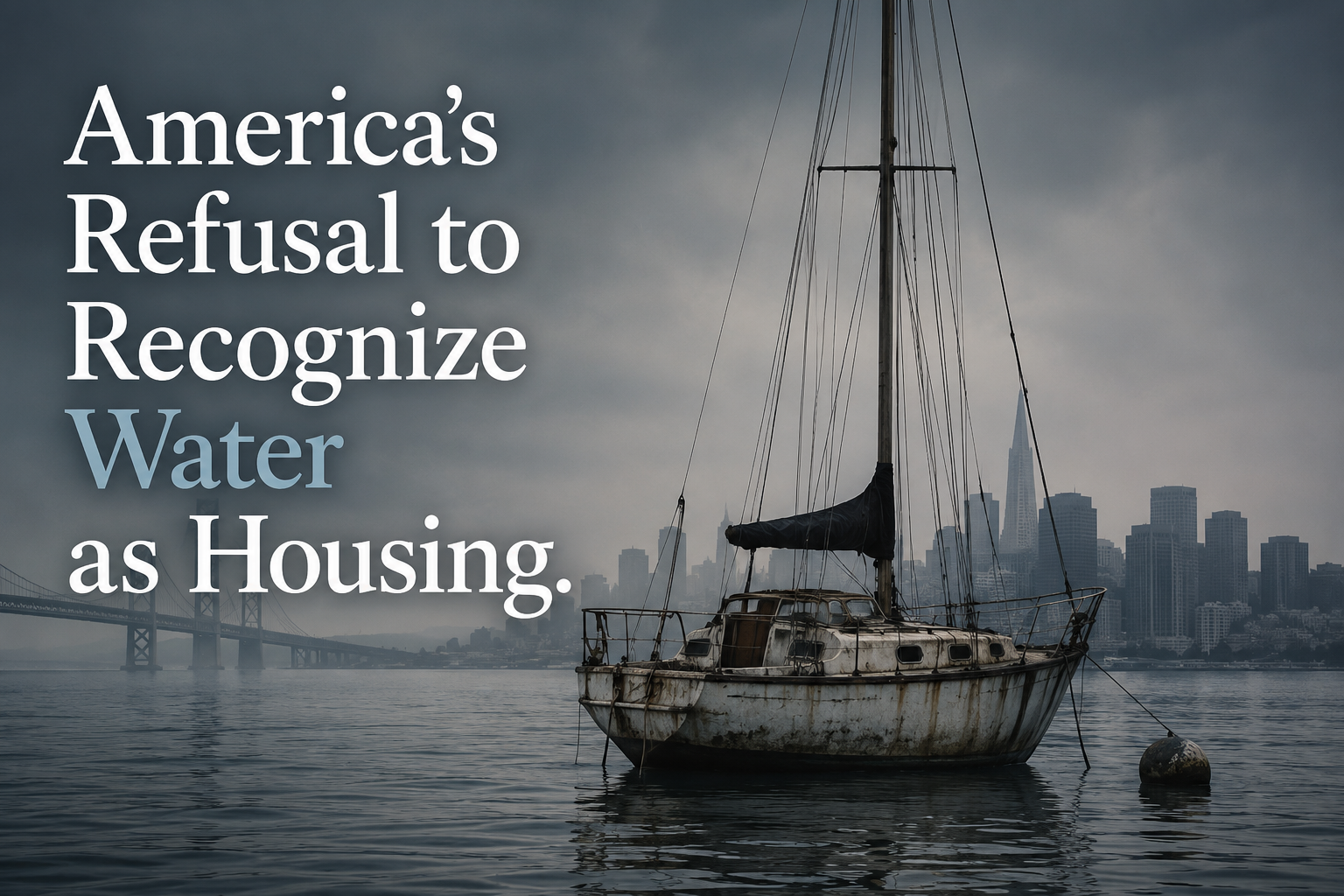
What the Slow Death of Richardson Bay’s Anchor-Out Community Reveals About America’s Refusal to Recognize Water as Housing
An editorial analysis from The Floating Residence
Five miles north of San Francisco, in a shallow arm of the bay framed by some of the most expensive residential hillsides in the United States, a housing category is being administratively extinguished. A decade ago, residents recall, more than two hundred vessels lay at anchor in Richardson Bay. Today, by the count of the people still living there, roughly thirty-five remain. The last of them operate under a deadline: participants in the agency’s “safe and seaworthy” program have until October 2026 to move their boats. After that, the anchorage that residents describe as one of the oldest continuously inhabited free anchorages in America will, for practical purposes, cease to exist as a residential community.
The story is usually told as a local land-use dispute — derelict boats, water quality, seagrass. It is more useful to read it as a case study in what happens to a form of housing that was never given a legal instrument to exist. The anchor-outs of Richardson Bay are not losing a fight over boats. They are losing a fight they were structurally guaranteed to lose the moment their tenure was defined by permission rather than by contract.
A community older than the agencies removing it
Vessels have anchored in Richardson Bay for well over a century. The Sausalito waterfront industrialized during the Second World War as a shipbuilding hub; when the war ended, the leftover hulls, barges, and workforce seeded the houseboat communities that made the town famous — and triggered the “houseboat wars” of the 1970s, a confrontation that displaced many residents and left behind the sanctioned, picturesque floating-home docks that tourists photograph today. The anchor-outs are the unsanctioned remainder of that history: people living at anchor, off the grid, hauling water, generating their own power, rowing to shore.
The regulatory machinery arrived in 1985, when the surrounding municipalities formed the Richardson Bay Regional Agency. Two years later the agency adopted a 72-hour anchoring limit — an ordinance that then sat largely unenforced for decades. This is the first structural fact worth dwelling on. For roughly thirty years, the rule existed and the community existed alongside it. Tolerance functioned as tenure. But tolerance is not tenure, and the difference became decisive after a state audit of the San Francisco Bay Conservation and Development Commission in the late 2010s pressured regulators to demonstrate enforcement. Enforcement, it turned out, meant the anchorage.
What followed, in the accounts of residents interviewed in the documentary footage this essay draws on, was rapid and often brutal: vessels designated as “marine debris” and seized, some crushed with excavators before owners could contest the designation, boats taken while their occupants were ashore buying groceries or sitting at hospital bedsides. Several seizures produced lawsuits; a number ended in settlements. The residents who fought describe the litigation asymmetry familiar to anyone who has faced a public agency with outside counsel — procedural motions, delay, and the simple arithmetic that a person living on a sailboat cannot outspend a joint-powers authority.
The current phase is gentler in form and identical in outcome. An eelgrass protection zone now covers most of the bay, with an October 2024 deadline to vacate it. A housing voucher program offers a path ashore, and many residents have taken it. The remainder face the 2026 horizon. The mechanism evolved from the backhoe to the incentive. The destination did not change.
The tell in the shifting rationale
Every removal campaign requires a public justification, and Richardson Bay’s has been notably unstable. First it was sewage — anchor-outs accused of fouling the bay, an accusation that sits awkwardly beside the state water board’s own monitoring data, which residents note shows the worst bacteria readings near the marinas and shoreline, with some of the lowest levels recorded near the anchorage itself, and beside the region’s documented municipal sewage releases, which are measured in the millions of gallons. Then the rationale became eelgrass.
The eelgrass argument deserves honest treatment, because it is not fabricated. Anchor chains scour seagrass beds; this is established marine science, and the residents themselves concede some damage. But the argument collapses under proportionality. Eelgrass does not grow beneath the region’s thousands of marina slips. The navigation channels and marinas are dredged on a recurring cycle — dredging being among the threats to eelgrass that the restoration partners themselves identify, alongside shoreline structures built over the water. Every major pressure on the plant maps to the sanctioned, revenue-generating waterfront. Only the unsanctioned residents were asked to leave.
When the stated reason for a policy keeps changing while the remedy stays constant, the remedy is the policy. The constant in Richardson Bay, across forty years and several justifications, is removal.
Why London keeps its boaters and America does not
The question practically asks itself: London’s canals host thousands of liveaboard narrowboats — a visible, celebrated, growing residential culture — while America crushes sailboats in one of its most famously liberal metropolitan areas. Why?
The romantic answer is cultural. The correct answer is architectural — legal architecture.
Britain has a national navigation authority, the Canal & River Trust (successor to British Waterways), and critically, it has a statutory category for the itinerant liveaboard. Under the British Waterways Act 1995, a boater without a home mooring may license a vessel as a “continuous cruiser,” paying an annual fee and accepting movement obligations. The arrangement is imperfect and increasingly contested — the Trust has tightened enforcement and raised fees on continuous cruisers in recent years — but the fight in Britain is over the terms of a recognized status. The boater holds an instrument: a license, with rights attached, from an authority whose mandate includes navigation and habitation alike.
The American anchor-out holds nothing. The United States never created an equivalent category. Anchoring rights in navigable waters exist in a jurisdictional fog — a federal navigation servitude here, state public trust doctrine there, a local ordinance layered on top — and residential anchoring falls through every gap. The anchor-out’s presence is permissive at best, illegal at worst, and contractual never. This is the distinction that decides everything. A liveaboard in a marina slip with a permit holds a contractual right to remain; the right can be defended, priced, transferred within rules, litigated on its merits. An anchor-out holds a position that any sufficiently motivated agency can reclassify as trespass, blight, or debris. When the reclassification comes, there is no lease to point to. There is only the argument that one has been there a long time — and duration, in American property law, is sentiment, not standing.
So the answer to “is it money, or power?” is: yes, but routed through structure. The money is obvious — Richardson Bay is ringed by eight-figure hillsides, and free anchorage on billion-dollar waterfront is an opportunity cost that wealthy shoreline communities were never going to tolerate indefinitely. The power is equally legible: the RBRA is a joint-powers agency constituted by and accountable to the shoreline municipalities. The people who live on the water it regulates have no representation within it. An agency built by waterfront homeowners, funded under pressure to demonstrate enforcement, governing a population with no vote, no lease, and no litigation budget, will produce exactly one outcome. It did.
But money and power only explain the motive. The legal vacuum explains the opportunity. Britain’s boaters survive not because Britain is kinder but because a nineteenth-century canal network, nationalized and then charitably reconstituted, happened to produce an institution that found it easier to license the liveaboards than to fight them. America’s waters produced no such institution, and so each anchorage community lives at the discretion of whichever local coalition forms against it.
Is it fair?
Fairness requires acknowledging what the anchor-outs’ defenders sometimes will not. Unmanaged anchorages have real failure modes. Some vessels were derelict. Some did drag anchor in storms, sink, leak fuel. A community with no entry standards absorbs people in crisis along with people in freedom, and the resulting spectrum — from immaculate cruising sailboats to rotting hulks — handed regulators their photographs. Residents themselves make this distinction bitterly: a minority who treated the anchorage as a campsite became the public face of a majority who did not. Any honest account concedes that a legitimate public interest exists in navigation safety, vessel standards, and waste management.
The unfairness lies not in the existence of regulation but in the refusal, across forty years, to build the obvious middle path. A managed mooring field — engineered moorings that eliminate anchor scour, a pump-out service (which residents recall once existed informally, two workers and twenty dollars a boat), vessel standards, a fee — would have addressed every stated environmental and safety concern while preserving the community. This is not a utopian invention; it is standard harbor management practice up and down the American coast. It was never seriously pursued in Richardson Bay because the stated concerns were never the operative ones. The operative concern was presence, and only removal cures presence.
Weigh the ledger honestly. On one side: modest, correctable environmental impacts and a maintenance problem concentrated in a fraction of the fleet. On the other: the elimination of the region’s least resource-intensive housing — residents heating homes through winter on a single propane tank, living car-light lives with near-zero footprints — in a metropolitan area suffering a catastrophic housing shortage, followed by relocation of those residents into car-dependent onshore housing at public expense. The environmental case, examined closely, inverts. What remains is an aesthetic and economic preference wearing an ecological costume. That is not fair. It is merely lawful — and only because the people it targets were never allowed a law of their own.
What dies with the anchorage
The voucher program deserves one genuine credit: after decades of seizures, it is the first time the removing authorities have accepted any obligation to the removed. Displacement with relocation is better than displacement without it. Several residents say so themselves, with the weary gratitude of people negotiating the terms of their own erasure.
But something categorical is lost. Richardson Bay was among the last places in America where a person could live on the water outside the marina system — outside slip fees, waiting lists, and liveaboard quotas — sustained by skill rather than by rent. That model has now been tested against American institutions and has failed, not on its environmental merits but on its legal ones. The lesson generalizes, and it is the central lesson this platform exists to teach: on the water, as on land, the durable asset is never the vessel. It is the right to remain — written, contractual, enforceable. The anchor-outs had seamanship, self-reliance, community, and forty years of history. They did not have paper. In the end, paper was the only thing that would have saved them.
Britain gave its water-dwellers a license. America gave its water-dwellers a deadline.
Sourcing note: The factual account of Richardson Bay above draws on documentary interviews with anchorage residents; figures such as the decline from roughly 200 vessels to roughly 35 reflect resident estimates rather than official counts. Institutional facts — the RBRA’s 1985 formation, the 1987 72-hour ordinance, the state audit of the BCDC, the eelgrass protection zone deadline of October 15, 2024, and the October 2026 safe-and-seaworthy deadline — are matters of public record and should be independently verified against agency documents prior to publication.
Disclosure: The author lives aboard a vessel under permit at a California harbor and writes on floating residence markets professionally.
Leave a Reply