
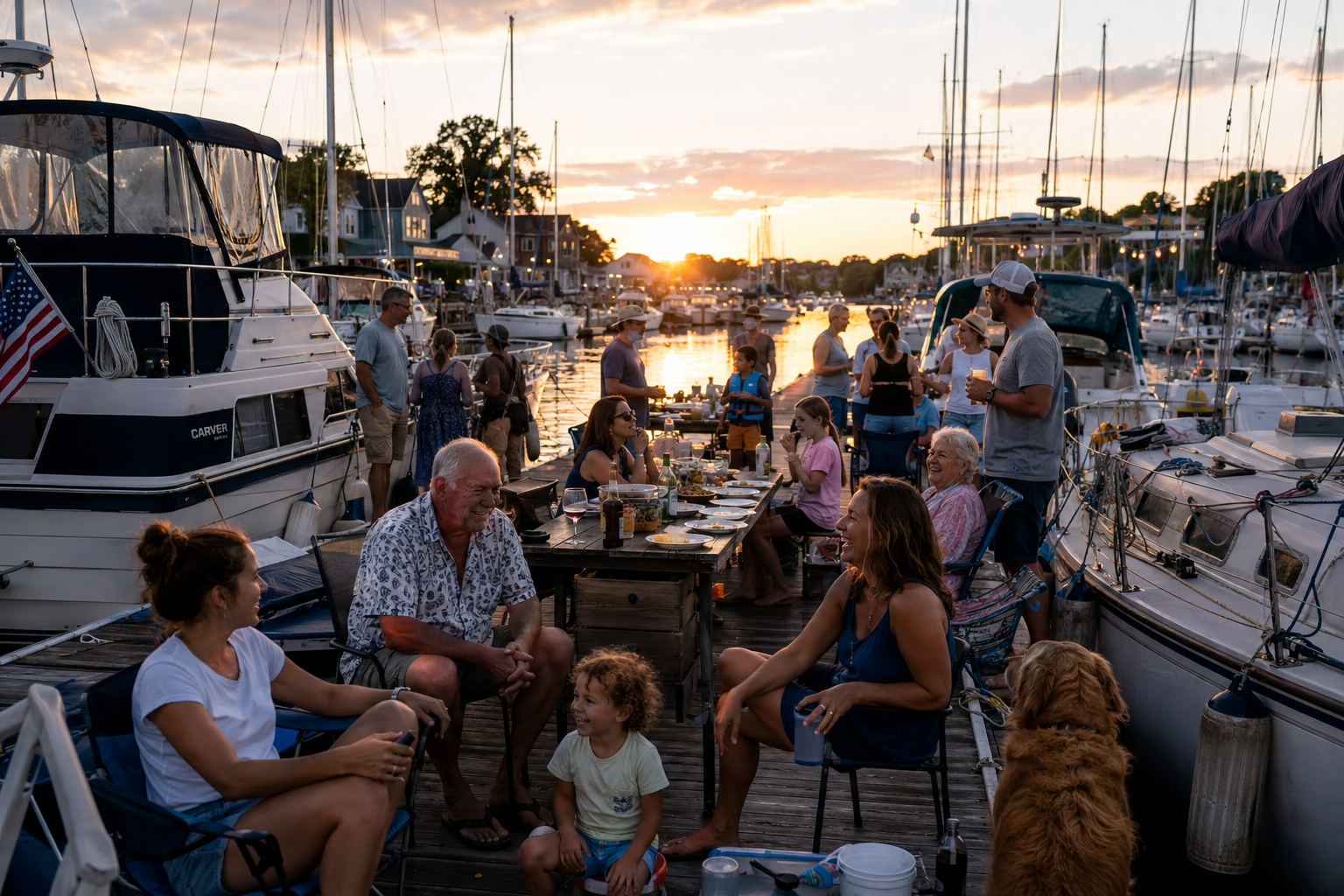
What Marinas Can Teach Us About Community in an Age of Disconnection
One of the most overlooked aspects of floating living has nothing to do with boats.
It has nothing to do with marinas, waterfront views, dolphins, sunsets, or even housing.
It has to do with something far more fundamental.
Community.
For all of humanity’s technological progress, many people today find themselves living through a strange contradiction.
We are more connected than any generation in history.
Yet many of us feel increasingly disconnected from one another.
We communicate instantly across continents. We participate in digital communities. We maintain endless streams of information and interaction.
Yet many people cannot name their neighbors.
Many neighborhoods have become collections of houses rather than collections of relationships.
Something important has been lost.
Researchers increasingly point to the decline of what some call the “civic layer” — the everyday spaces where people once gathered, collaborated, solved problems together, and built trust through repeated interaction. These were the places where community happened naturally rather than intentionally.
What is fascinating is that while many traditional neighborhoods have lost some of these qualities, marinas often continue to preserve them.
And in doing so, they may offer an unexpected glimpse into what community could look like in the future.
The Harbor as a Neighborhood
When most people picture a marina, they see boats.
What they often miss is the social infrastructure hidden beneath the surface.
A marina functions remarkably like a traditional neighborhood.
The docks become sidewalks.
The slips become lots.
The harbor becomes a shared public space.
Unlike many suburban environments, people naturally encounter one another throughout the day. Conversations occur while walking the docks. Neighbors help secure lines. Someone is always working on a project. Someone is always arriving. Someone is always preparing to depart.
These interactions may seem small.
But community is rarely built through grand gestures.
Community is built through repetition.
Repeated encounters.
Repeated assistance.
Repeated trust.
The simple act of helping a neighboring boater dock during a difficult wind can create more social connection than years of living next to someone behind a closed garage door.
Why Boaters Help Each Other
One reason marina communities often feel different is because life on the water naturally encourages cooperation.
When a boat owner faces an electrical issue, there is often an electrician nearby.
When an engine fails, a mechanic appears.
When someone struggles with lines, docking, or maintenance, help often arrives before it is requested.
Part of this comes from necessity.
Water has a way of reminding people that self-sufficiency is often an illusion.
Everyone eventually needs assistance.
And because everyone eventually needs assistance, most people willingly offer it.
This creates something increasingly rare in modern society:
Mutual dependence without social division.
The size of a person’s bank account matters far less when everyone eventually needs help repairing a pump, securing a vessel, or navigating weather.
On the docks, practical contribution often carries more weight than status.
The Return of Micro-Community
Researchers studying human well-being have repeatedly found that one of the strongest contributors to life satisfaction is feeling that we matter to others and that others matter to us.
This feeling rarely emerges from social media.
It emerges from participation.
Helping.
Contributing.
Belonging.
Marina life naturally creates opportunities for these experiences.
A neighbor catches your lines.
You help someone move a heavy generator.
Someone shares tools.
Someone shares knowledge.
Someone shares dinner.
Individually, these moments appear insignificant.
Collectively, they form the foundation of community.
The psychologist Isaac Prilleltensky describes this dynamic through the concept of “mattering” — the sense that we are valued by others and able to add value in return. Research consistently links this feeling to higher well-being, lower loneliness, and greater life satisfaction.
Marinas often produce these moments organically.
A Different Relationship With Consumption
Floating communities also challenge another modern assumption.
On land, neighborhoods are frequently organized around consumption.
Larger homes.
More possessions.
More upgrades.
More separation.
Life aboard tends to operate differently.
Space is limited.
Storage is finite.
People keep what they need.
They share what they do not.
Tools circulate.
Equipment circulates.
Knowledge circulates.
The emphasis shifts away from accumulation and toward utility.
This subtle change often strengthens community because relationships become more valuable than possessions.
People begin relying on one another rather than simply purchasing another solution.
The Urban Harbor Community
Perhaps the most interesting implication for the future is that marinas represent a model of what might be called the urban harbor community.
Historically, harbors have always been places where people, commerce, knowledge, and culture converged.
They were engines of connection.
Modern floating communities have the potential to continue that tradition.
Not as isolated enclaves.
Not as exclusive waterfront retreats.
But as highly connected neighborhoods where people live in closer relationship with one another, with their environment, and with the water itself.
As cities continue to grow and many people search for greater meaning, belonging, and community, the lessons found within marina life may become increasingly relevant.
Because the future housing conversation should not only focus on affordability.
It should also focus on connection.
The Floating Residence Perspective
At The Floating Residence, we often discuss floating living through the lenses of housing, marina access, economics, and lifestyle fit.
But there is another dimension that deserves equal attention.
Human connection.
The most valuable asset in a floating community may not be the boat.
It may not be the slip.
It may not even be the waterfront location.
It may be the relationships that form between people sharing a common environment and a common experience.
In an era increasingly defined by isolation, polarization, and digital distraction, floating communities quietly offer something many people did not realize they were missing.
A neighborhood.
Not simply a place to live.
A place to belong.
And as society continues searching for ways to rebuild the civic layer that once connected us, the floating neighborhood may prove to be one of the most unexpected and valuable models hiding in plain sight.