
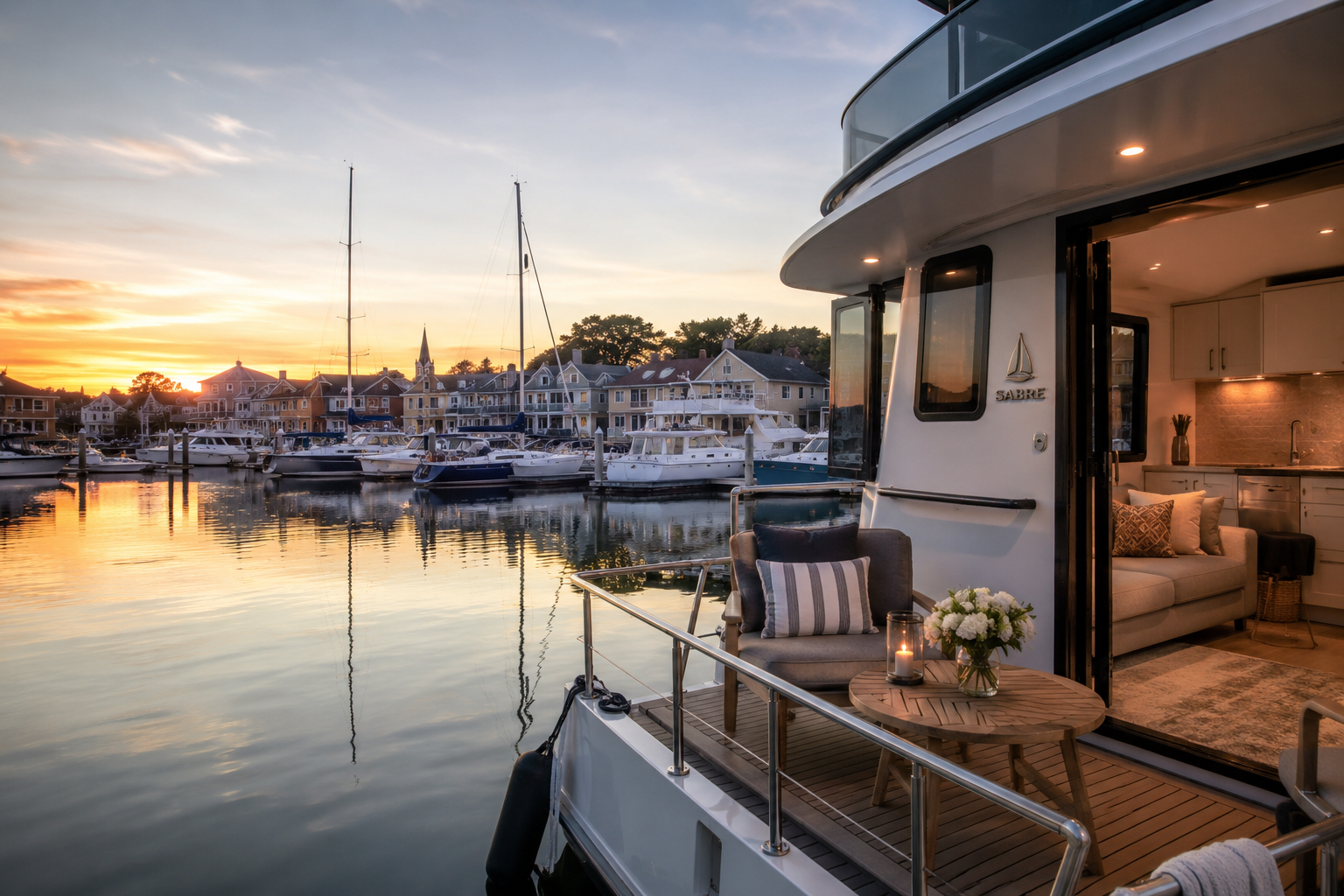
A Different Way to Access Coastal Life
For decades, coastal living has largely been defined through one model: land ownership.
The coastal home.
The waterfront condo.
The seasonal rental.
The second residence.
But in many regions, that equation is becoming increasingly difficult to access.
From Nantucket and Newport to the coastlines of Maine, Southern California, and the Pacific Northwest, waterfront real estate prices continue to rise while seasonal inventory becomes more constrained. For many people, the desire for time near the water remains strong — but the traditional ownership path no longer feels practical, flexible, or financially aligned.
This is where floating living begins to offer a different perspective.
Not as escapism.
Not as a fringe alternative.
But as another model for accessing coastal life.
Beyond Traditional Coastal Ownership
Floating living is often misunderstood because it is framed too narrowly.
The conversation typically centers around:
- full-time liveaboard lifestyles,
- boating culture,
- or recreational weekend use.
But there is an emerging middle ground that deserves far more attention: seasonal floating living.
In this model, the vessel becomes:
- a seasonal waterfront residence,
- a flexible coastal foothold,
- or a hybrid alternative to traditional second-home ownership.
Rather than purchasing a coastal property that may sit vacant much of the year, some people are beginning to reconsider whether floating infrastructure can provide a more flexible and intentional approach to waterfront access.
The Coastal Access Equation
In many desirable coastal markets, the largest barrier is no longer desire — it is entry cost.
Seasonal rentals continue to rise.
Waterfront homes remain supply constrained.
Taxes, insurance, maintenance, and long-term ownership obligations compound over time.
Floating living introduces a fundamentally different equation.
In some cases, the combined cost of:
- vessel ownership,
- marina access,
- utilities,
- and maintenance
may still remain significantly below the cost of seasonal coastal real estate.
More importantly, it introduces optionality.
The ability to:
- maintain a seasonal waterfront presence,
- experience different coastal regions,
- reduce unused square footage,
- and rethink how “home” functions throughout the year.
The Slip Is Often the Real Asset
One of the most overlooked aspects of floating living is that the vessel itself is only part of the equation.
The real scarcity often lies in:
waterfront access infrastructure.
Marina availability, slip access, harbor regulations, seasonal demand, and regional limitations all shape the viability of floating living far more than most people initially realize.
The boat may be visible and searchable.
The infrastructure behind the lifestyle often is not.
This is one reason floating living continues to remain misunderstood:
the market itself is fragmented, localized, and relationship-driven.
Seasonal Living as Lifestyle Design
For some, seasonal floating living is not primarily about cost savings at all.
It is about:
- slower mornings,
- proximity to water,
- simplified space,
- flexibility,
- and a different relationship to daily life.
The rhythms are different.
Morning coffee on deck.
Walking the docks at sunset.
Weather becoming part of the experience instead of something viewed through windows from a distance.
The appeal is not necessarily maximalism or luxury in the traditional sense.
Often, it is the opposite: intentionality.
Reconsidering Coastal Life
Floating living is not a universal solution.
Nor is it intended to romanticize life on the water.
It requires:
- infrastructure awareness,
- practical evaluation,
- financial clarity,
- and honest consideration of tradeoffs.
But as coastal real estate continues to evolve, floating living may increasingly become part of a broader conversation around:
- access,
- flexibility,
- alternative residency,
- and intentional waterfront life.
Not everyone needs a coastal house to experience the coast.
Sometimes the more interesting question is: what if access matters more than ownership?
Watch the Video
The Floating Residence
The Floating Residence explores floating living through the lens of:
- waterfront access,
- intentional design,
- housing reconsideration,
- and alternative approaches to coastal life.
Floating Well.